

Signals Before Impact: How Distributed Sensing and AI-Powered Foresight Create Smarter Awareness
Most organizations do not fail because they lack information.
They fail because they notice the right information too late.
By the time a disruption becomes visible in reports, markets, supply chains, infrastructure, ecosystems or public debate, the strategic window has often already narrowed. The signals were usually there earlier — scattered, weak, incomplete and easy to ignore. They appeared as anomalies, quiet observations, technical deviations, unusual patterns, minor complaints, local disruptions, environmental changes or emerging conversations.
The real challenge is not the absence of data.
The real challenge is turning scattered signals into early awareness before impact.
This is the idea behind Signals Before Impact: a practical approach to combining distributed sensing, weak signal detection, artificial intelligence and strategic foresight into one decision-support capability.
At SignaFutura, we help organizations see what others do not yet notice. Our work focuses on detecting early signals of change, interpreting their strategic meaning and turning them into clearer choices before the situation becomes obvious.
What Are Signals Before Impact?
Signals before impact are early indicators that something meaningful may be changing before the consequences are fully visible.
They are not always dramatic. In fact, the most important signals often look insignificant at first.
A weak signal may be a small technical anomaly in infrastructure data. It may be a repeated environmental observation from different locations. It may be a change in customer behavior that does not yet appear in sales numbers. It may be a new phrase gaining traction in public discussion. It may be a regulation, research finding or social pattern that has not yet reached mainstream attention.
Individually, these signals may look like noise.
Together, they can reveal direction.
This is where strategic foresight begins. Not with prediction, but with disciplined attention.
What Is Distributed Sensing?
Distributed sensing means collecting observations from many different points instead of relying on one centralized source.
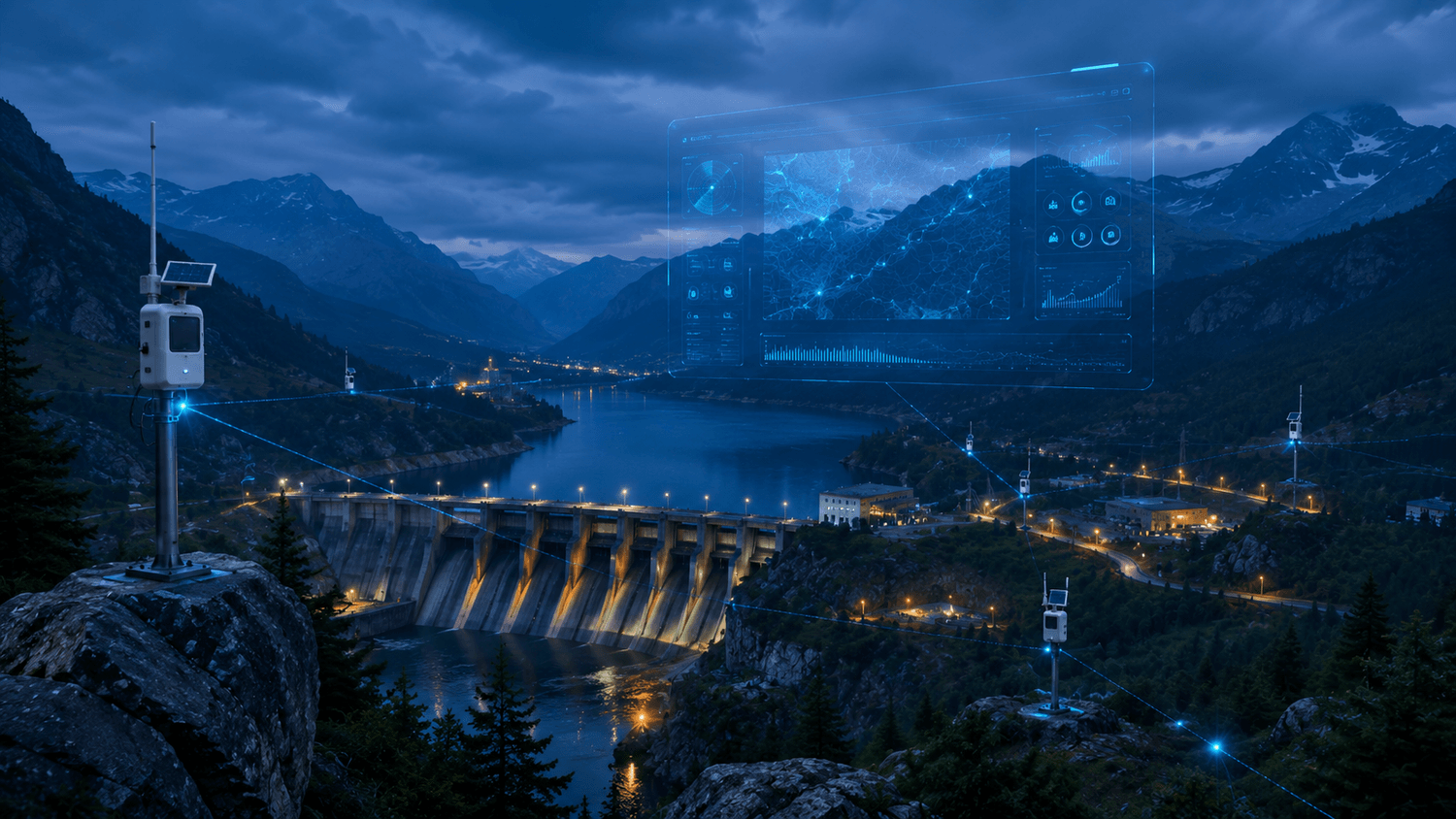
In a technical environment, this may involve sensors across infrastructure, energy systems, industrial sites, natural environments or critical assets. In a broader foresight context, distributed sensing also includes human observations, open data, research, public information, media signals, market indicators and domain-specific expert insight.
A distributed sensing model recognizes one important fact:
No single data source sees the whole system.
A sensor may detect a local anomaly. A person may notice a change in nature. A market dataset may reveal a pricing pattern. A researcher may publish an early finding. A social conversation may expose a shift in expectations. A news item may reveal a policy direction. Each source is limited, but together they form a living signal network.
The value is not only in collecting data.
The value is in connecting what was previously disconnected.
Why Traditional Monitoring Is No Longer Enough
Many organizations still rely on reactive monitoring. They measure what is already known, track familiar indicators and respond when thresholds are crossed.
That is useful, but it is not enough.
Traditional monitoring often answers questions such as:
What happened?
Where did it happen?
How severe is it now?
Strategic foresight must go further. It asks:
What may be emerging?
Which signals are repeating?
Which weak changes are connecting?
What could this mean if the pattern continues?
Where should we pay attention before the situation escalates?
This shift matters because uncertainty is no longer occasional. It is structural. Climate stress, geopolitical volatility, AI disruption, supply chain fragility, energy transition, cybersecurity risk and market instability all create environments where early awareness becomes a competitive advantage.
Organizations need systems that do not only report impact.
They need systems that detect the preconditions of impact.
The Role of AI in Weak Signal Detection
Artificial intelligence is valuable in foresight because it can process large volumes of scattered information faster than human teams can do manually.
But AI should not be treated as a magic prediction machine.
The real value of AI in strategic foresight is pattern recognition, clustering, summarization, anomaly detection, semantic comparison and signal prioritization. AI can help detect recurring themes across sources. It can compare new information against previous observations. It can highlight unusual changes.
It can group signals by topic, sector, geography, intensity or possible consequence.
In practice, AI can support weak signal detection by helping answer questions such as:
Which signals are new?
Which signals are repeating?
Which signals are becoming more intense?
Which signals connect to known megatrends?
Which signals may indicate emerging disruption?
Which signals require human expert review?
This is where human judgment remains essential. AI can detect patterns, but people must interpret meaning, context, relevance and action.
The best foresight systems do not replace experts.
They make expert attention sharper.
From Raw Data to Strategic Awareness
Data alone does not create foresight.
A dashboard full of indicators may still fail to support decision-making if nobody understands what the signals mean. The key is translation: moving from raw observations to strategic awareness.
A practical signal intelligence workflow has four stages.
First, signals are collected from multiple sources. These may include sensor data, field observations, research papers, public datasets, news, market indicators, policy updates and expert input.
Second, signals are structured. This means classifying them by source, location, theme, time, reliability, novelty and possible relevance.
Third, signals are connected. One observation rarely matters alone. Meaning emerges when signals begin to form a pattern.
Fourth, signals are interpreted. This is the strategic layer. What does the pattern suggest? What may happen next? What options does the organization have? What should be monitored more closely? What decisions can be prepared now?
This is the difference between information and foresight.
Information tells you what exists.
Foresight helps you understand what it may become.
Why Early Awareness Creates Strategic Advantage
The greatest value of foresight is time.
When an organization detects change early, it gains room to think, test, prepare and adapt. It does not need to panic. It does not need to wait until the market, environment or operating conditions force action.
Early awareness creates several forms of advantage.
It gives leaders more decision options. It allows teams to prepare scenarios before disruption becomes urgent. It helps organizations allocate attention toward emerging risks and opportunities. It reduces dependence on last-minute reaction. It supports resilience because decisions are made with broader context.
Most importantly, early awareness improves strategic timing.
Acting too late is expensive.
Acting blindly is dangerous.
Acting early with structured uncertainty is often the best position available.
Practical Use Cases for Distributed Sensing and AI Foresight
The Signals Before Impact model can support many types of organizations.
For research organizations, it can help identify emerging phenomena, unusual observations and early patterns that deserve deeper investigation.
For environmental initiatives, it can help turn scattered nature observations into shared signals. Local changes in species behavior, water conditions, seasonal timing, vegetation, silence, absence or anomaly can become part of a broader early-warning picture.
For industrial operators, it can support operational awareness by connecting technical data, external risk signals, infrastructure conditions, supply chain indicators and regulatory changes.
For infrastructure stakeholders, it can help detect early stress patterns across physical assets, environmental exposure, maintenance signals and regional disruption risks.
For security partners, it can provide a broader view of weak signals across geopolitical, technological, environmental and social domains.
For pilot collaborators, it can create a practical testbed for combining human observation, sensor data, AI-assisted analysis and strategic interpretation.
The core logic is the same across sectors:
Collect signals early.
Connect them intelligently.
Interpret them strategically.
Act before impact.
Why Weak Signals Are Difficult to Use
Weak signals are valuable because they appear early.
They are difficult because they are ambiguous.
A weak signal does not prove the future. It suggests that something may be changing. This creates a problem for traditional decision-making cultures, where leaders often want certainty before they act.
But by the time certainty arrives, advantage may be gone.
Strategic foresight requires a different mindset. It does not ask organizations to overreact to every small signal. It helps them build a disciplined way to monitor, compare and interpret uncertainty.
The question is not:
“Is this signal definitely important?”
The better question is:
“If this signal is part of a larger pattern, what should we understand now?”
This is the practical value of foresight. It makes uncertainty usable.
Human Observation Still Matters
In a world increasingly shaped by AI, it is tempting to believe that technology alone will solve awareness.
It will not.
Some of the most important signals are still noticed first by people: field workers, researchers, local communities, operators, entrepreneurs, customers, citizens and
experts who recognize when something feels different.
A sensor can measure.
A person can notice meaning.
AI can process.
A strategist can interpret.
The future of foresight is not purely automated. It is hybrid. The strongest systems combine human observation, machine analysis and strategic judgment.
This is especially important in environmental and societal contexts, where small changes may not yet exist as structured data. A local observation may be the beginning of a larger pattern. Without human input, it may never enter the system at all.
Distributed sensing is therefore not only a technical architecture.
It is also a human intelligence network.
From Signals to Decisions
A signal has no strategic value unless it changes how decisions are made.
This is why SignaFutura focuses not only on detecting weak signals, but on translating them into decision support.
A useful foresight process should help leaders answer three simple questions:
What are we seeing?
Why does it matter?
What should we do next?
This structure prevents foresight from becoming abstract. It connects observation to implication and implication to action.
The outcome may be a monitoring priority, a strategic scenario, a pilot project, a risk review, a market experiment, a partnership decision or a preparedness plan.
The goal is not to predict one fixed future.
The goal is to improve the quality of decisions under uncertainty.
SignaFutura: AI-Powered Strategic Foresight for Early Signal Detection
SignaFutura is built around a clear idea:
Organizations need better ways to detect change before it becomes obvious.
We work at the intersection of weak signal detection, AI-assisted analysis, distributed sensing and strategic foresight. Our approach helps organizations move from scattered information to clearer awareness, and from awareness to practical decisions.
We are especially interested in projects where early signals matter: environmental change, infrastructure risk, emerging technologies, market disruption, operational resilience and strategic uncertainty.
Our perspective is practical. We do not claim certainty. We do not sell artificial confidence. We build systems, methods and interpretations that help organizations see earlier, think better and prepare more intelligently.
The future rarely arrives without warning.
The warning is often just quiet.
Who Should Use This Approach?
This approach is relevant for organizations that operate in complex, changing or high-impact environments.
It is especially useful when decisions must be made before complete certainty is available.
If your organization needs to monitor emerging risks, detect early environmental or technical change, understand market shifts, identify weak signals, prepare strategic scenarios or build AI-supported decision intelligence, then distributed sensing and foresight can provide a practical advantage.
The organizations that benefit most are not necessarily the largest.
They are the ones willing to pay attention early.
Final Thought: The Impact Is Not the Beginning
Impact is rarely the beginning of change.
Impact is the moment when change becomes impossible to ignore.
The real beginning happened earlier, in the weak signals: the anomaly, the silence, the pattern, the repeated observation, the small deviation, the first warning
.
The organizations that learn to see before impact gain something valuable.
They gain time.
And in uncertain environments, time is strategy.

If your organization is looking for expertise in AI-powered strategic foresight, weak signal detection, distributed sensing, environmental intelligence or early warning systems, SignaFutura can help you turn scattered signals into practical awareness.
SignaFutura – See What Others Don’t Yet Notice.
FAQ
What is AI-powered strategic foresight?
AI-powered strategic foresight is the use of artificial intelligence to support the detection, analysis and interpretation of early signals of change. It helps organizations identify emerging risks, opportunities and disruptions before they become obvious.
What is weak signal detection?
Weak signal detection means identifying early, uncertain or subtle indicators that may point toward future change. Weak signals are often incomplete or ambiguous, but when connected with other signals they can reveal emerging patterns.
What is distributed sensing?
Distributed sensing means collecting observations from many sources instead of relying on one central data point. These sources can include sensors, human observations, open data, research, market information, news and expert insight.
How does SignaFutura help organizations?
SignaFutura helps organizations detect weak signals, connect scattered observations, interpret emerging patterns and translate foresight into strategic decisions. The focus is on early awareness before impact.
Who needs distributed sensing and foresight?
Distributed sensing and foresight are useful for research organizations, environmental initiatives, industrial operators, infrastructure stakeholders, security partners and pilot collaborators working in uncertain or high-impact environments.
Join the SignaNatura list and help us build a listening network for nature’s weak signals.